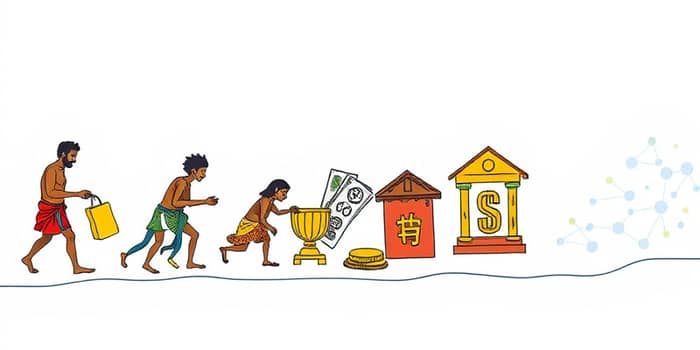
Money has undergone a radical transformation over millennia, reflecting groundbreaking innovations that reshaped trade and human collaboration. This article explores how societies moved from simple exchanges to sophisticated digital ledgers, offering insights that inspire and equip readers to understand modern finance.
Barter System (Pre-6000 BC to ~3000 BC)
The earliest form of trade relied entirely on direct exchange of goods or services, known as the barter system. People swapped items of mutual need, such as wheat for boots or pottery for clothing. While this approach fostered community bonds and local cooperation, it was inherently limited by the double coincidence of wants.
Archaeological findings trace barter to around 6000 BC, with long-distance trade flourishing by 3000 BC between Mesopotamia and the Harappan civilization. Traders exchanged precious commodities—gold, silver, ivory, spices, salt, silk—traversing vast landscapes without standardized currency.
Despite enabling early specialization, the barter model struggled with timing mismatches, transportation difficulties, and valuation disputes. Communities yearned for a more efficient mechanism to support growing economic complexity.
Commodity Money (Bronze Age, ~3000 BC onward)
As trade networks expanded, societies adopted commodity money—items possessing intrinsic or widely recognized value—to streamline exchanges. This shift addressed barter’s core limitation and introduced a common measure for goods.
- Ax heads and bronze knives circulated as standardized units
- Cowrie shells, salt, and whale teeth acted as portable wealth
- In some regions, beans and banana stems served as mediums
By using commodity money, traders no longer needed simultaneous wants to transact. A bean seller could accept shells today and later trade them for desired goods, resolving timing and valuation challenges. This innovation laid a foundation for modern economies.
Metal Coins and Early Coinage (Renaissance Era, ~15th Century)
The invention of coin minting revolutionized commerce with stamped metals guaranteeing weight and purity. The cylinder press allowed authorities to produce coins in consistent sizes, denominations, and designs, significantly reducing counterfeiting risks.
However, a proliferation of regional currencies created confusion. Merchants faced an overwhelming variety of coins, each with different metal content and acceptance rates. High-denomination coins were profitable to mint, but local markets demanded low-value coins for everyday transactions.
Italian banking families like the Medici introduced currency exchange services, facilitating trade across city-states. Governments soon recognized the benefits of centralized coinage and began monopolizing production, marking an early form of monetary policy and laying groundwork for nation-states’ economic control.
Paper Money and Banking (807 AD onward)
The advent of paper money in China’s Tang Dynasty around 807 AD addressed issues of portability and security. Merchants deposited metal coins or bullion with trusted notaries and received paper receipts, avoiding the bandit risk and logistical challenges of transporting heavy metals.
This concept spread along trade routes, appearing in the Mongol Empire and reaching India. European bankers later adopted similar systems, evolving into modern banks that accepted deposits, issued notes, and provided loans.
Over time, central banks acquired exclusive rights to issue currency, reducing fragmentation and enhancing monetary stability.
Fiat Money, Gold Standard, and Digital Fiat (20th Century)
By the 20th century, most currencies transitioned to fiat money—government-backed notes without intrinsic metal value. The gold standard persisted in various forms until mid-century but gradually gave way to purely fiat systems.
Advancements in electronic banking from the 1950s introduced debit cards and computerized transfers, while online payment platforms in the 1990s made digital fiat ubiquitous. These systems improved accessibility but remained dependent on trusted intermediaries in centralized networks, incurring transaction fees and time delays.
Cryptocurrencies and Blockchain (2008 Onward)
In 2008, a pseudonymous innovator, Satoshi Nakamoto, published the Bitcoin whitepaper, proposing a new electronic cash system without third parties. Bitcoin’s blockchain used cryptographic proof to prevent double-spending and distribution across a peer-to-peer network.
- Decentralized ledger with no central authority
- Transparent and auditable public records
- Fast global settlement around the clock
- Layer 2 solutions for instant microtransactions
Ethereum expanded on this by enabling smart contracts—self-executing code that automates agreements. Its shift to proof-of-stake drastically reduced energy consumption compared to proof-of-work models.
Today, over 130 central banks explore CBDCs, blending digital fiat with distributed ledger technology. Countries like Nigeria and the Bahamas have live digital currencies, demonstrating government-led innovation in payment rails.
Global blockchain infrastructure supports both private and public networks for payments, settlements, and asset management. Enterprises leverage these systems to optimize cross-border transactions, manage risk, and ensure compliance, signaling a shift toward programmable money rails and systems.
As money’s evolution continues, blockchain represents both a culmination of ancient challenges and a starting point for future financial ecosystems. By understanding this journey, individuals and institutions can navigate emerging technologies with confidence, contributing to more inclusive, efficient, and transparent economic landscapes.
References
- https://www.hiro.so/blog/tracing-the-social-narratives-shaping-the-future-of-money-bartering-to-banknotes-to-bitcoin
- https://stripe.com/resources/more/blockchain-payment-overview
- https://www.caixabankresearch.com/en/economics-markets/monetary-policy/barter-cryptocurrency-brief-history-exchange
- https://bvnk.com/blog/blockchain-payments
- https://netts.io/blog/money-history-barter-cryptocurrency
- https://en.wikipedia.org/wiki/Blockchain
- https://rmafed.com/from-barter-to-bitcoins-the-evolution-of-international-money-transfers/
- https://us.etrade.com/knowledge/library/cryptocurrency/what-is-blockchain-technology-beginners-guide
- https://www.itrustcapital.com/learn/from-barter-to-bitcoin-the-evolution-of-money-throughout-history
- https://aws.amazon.com/what-is/blockchain/
- https://guides.loc.gov/fintech/21st-century/cryptocurrency-blockchain
- https://crypto.com/en/university/history-of-money-barter-to-bitcoin
- https://www.fidelity.com/learning-center/trading-investing/crypto/blockchain-101
- https://www.youtube.com/watch?v=RGQCzVgmZrs