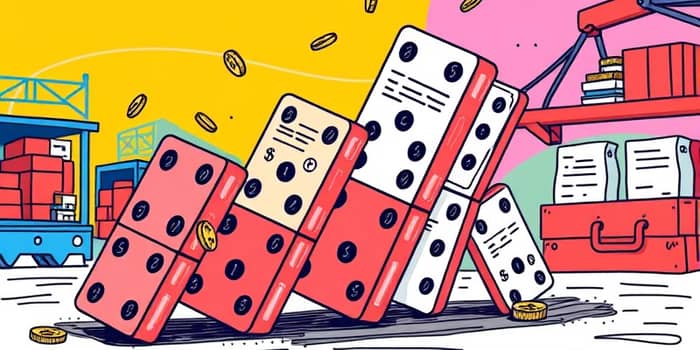
The world of finance often mirrors a line of dominoes: when one falls, others are destined to follow. Understanding this phenomenon can help businesses and individuals safeguard their stability or even turn debt into an opportunity.
Understanding the Financial Domino Effect
In financial contexts, the domino effect refers to a chain reaction triggered when one company or individual fails to meet obligations, causing failures across an interconnected network. When a firm cannot pay suppliers or creditors, unpaid invoices create cash shortfalls that ripple outward.
Even a single delayed payment can set off a sequence of insolvencies, illustrating how closely linked modern supply chains and credit systems truly are.
Global data underscores the scale of this risk: global insolvencies increased by 25% year-over-year in 2021. At the same time, 11.0% of all invoices are paid late, representing a staggering USD 1.01 trillion per year. Of these, 7.5% of invoices eventually written off become bad debt, while between 5% and 10% of administrative work in companies is devoted solely to chasing late payments.
Supply Chain Vulnerabilities and Severity
The severity of cascading failures depends on several critical factors that determine how quickly and widely disruptions spread.
- Market liquidity and access to credit
- Sales or supply concentration
- Dependency levels across networks
When liquidity dries up or credit lines tighten, even healthy firms can struggle to meet payroll or supplier invoices. High dependency on a single customer magnifies the fallout if that customer defaults, turning a localized issue into a systemic crisis.
Impact on Small and Medium Businesses
Small and medium enterprises (SMEs) often bear the brunt of late payments and cascading defaults. Their limited cash reserves and tighter margins leave little room for unexpected shortfalls.
- Delayed cash flows can grind operations to a halt
- Reduced investment capacity limits growth prospects
- Strained supplier relationships hinder production scaling
- Additional administrative burden drains resources
When an SME’s revenue falters, payment obligations to its own suppliers may be delayed, triggering a knock-on effect if suppliers also rely on incoming money to meet their bills. The result can be a vicious cycle, where one default leads to another, risking business closure and job losses.
Real-World Cautionary Example
A highly profitable manufacturing company in Sheffield illustrates how even apparent success cannot shield against hidden vulnerabilities. Their main contractor’s abrupt insolvency halted all work, leaving leased vehicles idle and employees without tasks.
In a matter of days, the company went from strong cash flow to potential insolvency. Their overreliance on one client—and failure to assess the client’s own network stability—created a crisis that was "two removed" but hit them directly.
Turning the Domino Effect Positive: The Debt Snowball Method
While defaults can propagate destruction, the domino effect can also fuel financial recovery when managed strategically. The Debt Snowball Method harnesses compounding momentum to pay off obligations systematically.
Step 1: Organize all debts by balance size, noting interest rates and minimum payments.
Step 2: Redirect extra funds to the smallest balance until it’s cleared, then roll that payment into the next debt.
Step 3: Continue this chain reaction until all debts are extinguished, using each successful payoff to accelerate the next.
By treating each payoff as a domino, you build confidence and free up resources more quickly, transforming overwhelming balances into manageable, step-by-step victories.
Systemic and Economic Implications
On a macro scale, widespread late payments and cascading defaults can slow economic growth. SMEs represent a significant portion of employment and output; when they falter, unemployment rises and consumer demand weakens.
Complex financial instruments with layered collateral values add another layer of risk. Without transparency, hidden debts can accumulate unnoticed until a systemic shock reveals them all at once, amplifying the crisis.
Building Business Resilience Against Cascading Failures
To mitigate the domino effect, companies must proactively strengthen their financial defenses. Adopting diverse strategies can prevent a single point of failure from toppling the entire structure.
- Diversify client base to reduce dependency risk
- Assess extended supply chain vulnerabilities proactively
- Maintain robust financial reserves as contingency buffers
- Monitor payment patterns and enforce credit policies
- Develop swift response capability for sudden disruptions
Regularly stress-testing cash-flow forecasts and conducting due diligence on key partners can further harden your organization against external shocks.
Key Takeaways
The domino effect in finance acts as both a potential threat and a powerful tool. Recognizing how one failure cascades through a network can help businesses avoid catastrophic chain reactions.
Likewise, individuals and firms can apply the same principles to accelerate debt reduction and reclaim financial stability. By maintaining vigilance, diversifying exposures, and building momentum through structured payoffs, you can turn a risky cascade into a pathway for growth.
Ultimately, preparedness and strategic action transform the domino effect from a hazard into a roadmap for resilience and success.
References
- https://www.allianz-trade.com/en_TW/resources/resources-archive/insolvency-risk--the-covid-19-domino-effect-explained.html
- https://www.moneyfit.org/the-financial-domino-effect/
- https://www.leonardcurtis.co.uk/news/beware-the-domino-effect-of-bad-business-debt
- https://www.basicmoneysense.com/blog/the-financial-domino-effect-how-one-small-win-can-change-everything