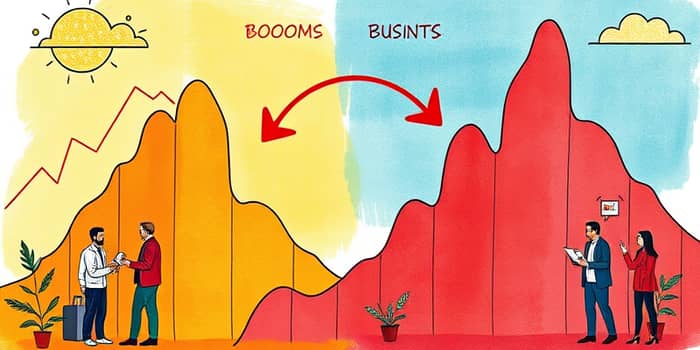
Economic activity ebbs and flows in predictable patterns yet demands strategic foresight. By understanding each phase, investors can turn uncertainty into opportunity.
Understanding Economic Cycles
At its core, a business cycle reflects recurring fluctuations in economic output around a long-term trend. Measured primarily by GDP growth, these cycles consist of four phases: expansion, peak, contraction, and trough/recovery. While durations vary, each phase exhibits characteristic shifts in employment, spending, inflation, and market sentiment. Recognizing where the economy stands can empower investors to align portfolios with evolving conditions rather than react when it’s too late.
Key Economic Indicators to Watch
Investors should monitor primary metrics to pinpoint phase transitions and adjust strategies accordingly.
- GDP growth rates: Signals expansion or contraction when rising or falling.
- Unemployment levels: Hires climb in booms, layoffs surge in busts.
- Inflation trends: Moderate in expansion, peaking before slowdown.
- Consumer and business confidence indices: Reflect future spending momentum.
- Interest rate movements: Low early, then rising to cool overheating.
- Stock market performance: Bullish in booms, bearish during contractions.
Historical Context and Variability
Business cycles repeat yet resist precise timing. The average post–World War II expansion lasted around five years, though some cycles ran shorter or longer based on policy responses, external shocks, or structural shifts. For example, the 2008–2009 Great Recession saw a severe contraction followed by a gradual recovery shaped by unprecedented monetary stimulus. No two cycles mirror each other entirely, underscoring the need for adaptive strategies rooted in data rather than fixed calendars.
Causes of downturns range from credit excesses to supply shocks or abrupt demand shifts. Similarly, recoveries gain traction through policy incentives, restored confidence, and pent-up consumer demand. By studying past cycles, investors can appreciate how quickly indicators turn and which assets historically rebounded first.
Sector Performance Across Phases
Different industries shine or struggle depending on economic momentum. During expansions, cyclical sectors such as consumer discretionary, industrials, and technology typically outperform as demand strengthens. Conversely, defensive sectors like utilities and healthcare hold up better during contractions when spending wanes. Interest-sensitive industries, including real estate and financials, benefit early in recoveries as borrowing costs fall and lending picks up.
Understanding sector rotation allows investors to anticipate shifts rather than chase performance. While broad market indices provide general direction, targeted allocations can enhance returns and mitigate risk when phases turn unexpectedly.
Investment Strategies for Each Phase
Phase-specific tactics help balance growth and preservation:
- During expansion: Emphasize growth stocks, small caps, and cyclical sectors. Consider leveraging low unemployment rates and steady growth by increasing equity exposure and reducing debt positions.
- At the peak: Gradually trim riskier holdings. Introduce hedges or diversify into assets less sensitive to economic swings.
- In contraction: Shift to defensive assets. Embrace bonds, high-quality dividend stocks, and cash equivalents. Focus on income stability over capital gains.
- Through trough and recovery: Re-enter undervalued cyclicals. Prioritize sectors likely to benefit from rising consumer confidence and spending early in the rebound.
Practical Tips for Investors
To navigate cycles effectively, consider these guiding principles:
- Diversifying across asset classes and sectors reduces volatility when phases reverse.
- Maintaining liquidity reserves ensures you can capitalize on discounted opportunities during downturns.
- Rebalancing periodically helps lock in gains from outperforming assets and redeploy into areas poised for growth.
- Monitoring leading indicators—such as yield curve inversions or manufacturing surveys—can offer early warnings of shifts.
- Adopting a long-term perspective prevents knee-jerk reactions to short-lived fluctuations.
Conclusion: Embracing the Cycle
No market remains in perpetual motion without pauses. Economic ebbs and flows present both risks and opportunities. By understanding each phase’s hallmarks and aligning investments with evolving conditions, investors can protect capital during busts and capture gains in booms.
Ultimately, navigating cycles with informed confidence transforms unpredictable markets into structured pathways for growth. Cultivate patience, stay vigilant with indicators, and adapt strategies as the cycle turns. In doing so, you position your portfolio to thrive through booms and busts alike.
References
- https://www.sofi.com/learn/content/what-is-the-business-cycle/
- https://www.theinvestorspodcast.com/business/understanding-the-business-cycle/
- https://www.britannica.com/money/stages-of-economic-cycle
- https://corporatefinanceinstitute.com/resources/economics/economic-cycle/
- https://www.fe.training/free-resources/asset-management/stages-of-the-economic-cycle/
- https://www.stlouisfed.org/publications/page-one-economics/2023/03/01/all-about-the-business-cycle-where-do-recessions-come-from
- https://onemoneyway.com/en/blog/economic-cycles/
- https://trilogyfunds.com.au/blog/financial-literacy/history-repeats-understanding-the-four-phases-of-economic-cycles/
- https://analystprep.com/cfa-level-1-exam/economics/business-cycle-and-its-phases-2/
- https://www.guidantfinancial.com/blog/business-cycles/
- https://www.youtube.com/watch?v=G8VE6xFLyzA
- https://www.stlouisfed.org/publications/page-one-economics/2023/03/01/all-about-the-business-cycle-where-do-recessions-come-from?edu-embed=1