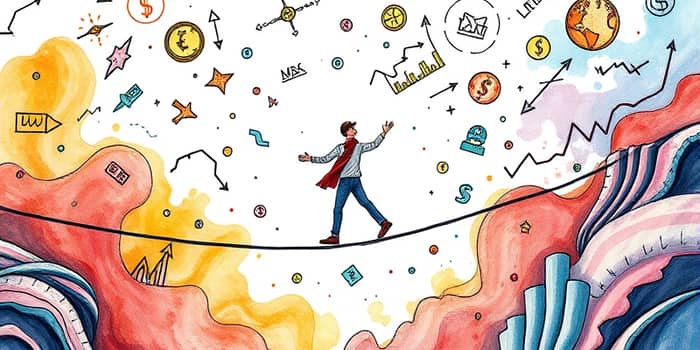
Facing an unpredictable financial world can feel overwhelming. Yet, with the right tools and know-how, individuals and institutions can transform uncertainty into opportunity. Derivatives, while often perceived as complex, serve as powerful instruments to manage risk, enhance returns, and navigate market turbulence with confidence.
By diving into their mechanics, uses, and safeguards, you can harness these contracts to build resilience and seize strategic advantages.
Understanding the Core Purpose of Derivatives
At their essence, derivatives are financial contracts whose value is derived from underlying assets—stocks, bonds, commodities, currencies, or benchmarks. They allow participants to trade specific risks without owning assets, facilitating everything from hedging against adverse price swings to speculating on future movements.
Whether you are a multinational firm protecting profit margins or an individual investor seeking targeted exposure, derivatives provide pathways to:
- Lock in prices or rates far in advance
- Speculate on rising or falling markets with leverage
- Exploit pricing inefficiencies through arbitrage
- Generate additional income by writing options
Forwards and Futures: Locking in Tomorrow’s Certainty
Forwards are customized, over-the-counter contracts obligating two parties to exchange an asset at a predetermined price on a specified future date. Their flexibility allows tailoring of quantity, settlement date, and currency. However, this bespoke nature brings higher counterparty risk due to the absence of centralized clearing.
- Window forwards for variable settlement dates
- Long-dated forwards extending up to ten years
- Non-deliverable forwards settled in cash
- Flexible/open forwards for dynamic hedging
In contrast, futures are standardized, exchange-traded agreements that lock in price and date while benefiting from transparent pricing and daily margin settlements via clearinghouses.
- Stock futures on single-company equity
- Index futures tracking major benchmarks
- Currency futures fixing exchange rates
- Commodity futures across agricultural and energy markets
- Interest rate futures on government debt instruments
From farmers securing crop revenue to airlines stabilizing fuel costs, these two instruments form the backbone of tailor-made risk mitigation strategies around the globe.
Swaps: Crafting Custom Cash Flow Solutions
Swaps are over-the-counter agreements in which counterparties exchange future cash flows or liabilities. They offer precision in managing exposures without trading the underlying assets directly.
Through swaps, corporations and financial institutions can shift exposures with pinpoint accuracy, aligning cash flows to strategic objectives and regulatory requirements.
Options: Embracing Flexibility and Opportunity
Options grant buyers the right—but not the obligation—to purchase (call) or sell (put) an underlying asset at a specified strike price by or on expiry. This conditional structure offers powerful flexibility.
- Call options to profit from anticipated price rises
- Put options to insure against market downturns
- Currency options to manage foreign exchange risk
With an upfront premium as the only potential loss, options deliver powerful leverage with limited downside, making them ideal for hedgers seeking protection and speculators aiming to amplify returns.
Strategies for Empowered Application and Management
When wielded thoughtfully, derivatives can become cornerstones of a diversified financial strategy. Key approaches include:
- Hedging to reduce volatility in cash flows or asset portfolios
- Speculation to capitalize on directional market views
- Arbitrage to exploit pricing inefficiencies across venues
- Income generation through option writing and structured products
Successful implementation hinges on education, disciplined risk limits, and ongoing monitoring. By combining balanced analysis and informed decision making with robust governance, practitioners can unlock sustainable benefits.
Risks and Considerations: Navigating the Path with Wisdom
Despite their advantages, derivatives carry inherent challenges. Leverage can magnify losses as swiftly as gains, while over-the-counter contracts introduce counterparty default risk. Futures positions may trigger margin calls, and options are subject to time decay and volatility changes.
Complexity demands rigorous oversight. Before engaging, investors should build domain expertise, employ stress tests, and maintain sufficient liquidity buffers. Regulatory frameworks, such as exchange clearing and collateral requirements, further safeguard market integrity.
Conclusion: Harnessing the Power of Derivatives
Derivatives stand as a testament to financial innovation—offering avenues to manage uncertainty, amplify insights, and pursue targeted outcomes. By grasping their core mechanics, respecting their risks, and applying them with strategic intent, you can transform market ambiguity into dynamic opportunity.
Embrace the journey of learning, apply prudent safeguards, and let derivatives become instruments of empowerment in your financial toolkit.
References
- https://training-nyc.com/learn/stock-market-investing/financial-derivatives
- https://www.youtube.com/watch?v=XqBzFpB8jSY
- https://www.geeksforgeeks.org/finance/types-of-derivatives-in-financial-market/
- https://pi.math.cornell.edu/~mec/Summer2008/spulido/Derivatives.html
- https://wholesale.banking.societegenerale.com/en/news-insights/glossary/derivatives/
- https://www.fow.com/derivatives
- https://www.occ.treas.gov/topics/supervision-and-examination/capital-markets/financial-markets/derivatives/index-derivatives.html
- https://www.imf.org/external/np/sta/fd/
- https://www.masterclass.com/articles/derivative-meaning