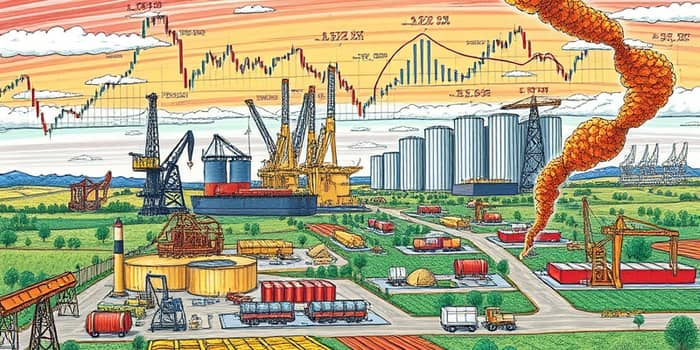
The world of raw materials is in constant flux. As global economies shift and geopolitical landscapes evolve, understanding commodity markets is essential. This in-depth exploration offers readers a clear lens through which to view price trends, sector dynamics, and risk factors shaping the near future.
Market Overview and Price Trends
The global commodity market is experiencing significant shifts, as overall prices are projected to fall by approximately 12 percent in 2025. This anticipated downturn represents a multi-year low bound to test supply resilience and investor confidence. Factors such as slower economic growth, trade policy changes, and inventory levels converge to influence these dynamics.
Between March and August 2025, primary commodity prices dipped by 2.6 percent. However, large gains in precious metals partially offset this broad-based decline and highlighted the sector’s defensive qualities during periods of uncertainty. Analysts forecast a further 5 percent drop in aggregate prices through 2026, underscoring the need for strategic positioning.
To illustrate the outlook:
Energy Sector Dynamics
The energy landscape presents both challenges and opportunities. In the oil market, a complex outlook driven by the OPEC+ dilemma hangs over supply decisions. With weak global demand, producers face a choice: maintain cuts to support prices or boost output to preserve market share, each path carrying its own risks.
Meanwhile, natural gas is poised for a resurgence. The expiration of the Russia-Ukraine five-year pipeline deal has introduced supply uncertainty in Europe, propelling demand for liquefied natural gas. U.S. export capacity expansions in the Gulf of Mexico position the country as a leading supplier, while industrial growth and pipeline exports further underpin domestic price support.
- Increased LNG export infrastructure in the United States.
- Rising power demand driven by electrification efforts.
- Coal-to-gas switching amid environmental regulations.
Metals and Mining Sector
Steel markets are under pressure from persistent overcapacity. Domestic demand in China remains subdued, particularly in the property sector, while mills export aggressively to avoid losing market share. New capacity coming online in 2025 threatens to exacerbate this imbalance.
In contrast, growing demand for critical metals and minerals offers a bullish counterpoint. Latin America, Africa, and Asia have seen more prepayments from investors eager to secure supply. Uranium, in particular, stands out: with prices forecast to reach $100 per pound by the end of 2026, nuclear energy’s resurgence drives a robust risk skew.
The precious metals complex has delivered stability, led by gold’s rally. Central bank purchases have bolstered prices, and a dovish shift in monetary policy could ignite broader gains in copper and aluminum by 2026.
Agricultural Commodities
Global grain markets remain well supplied, with stocks-to-use ratios near historical highs. Soybean inventories for 2024/25 are at a 17-year peak, thanks to abundant Brazilian harvests. Maize ratios mirror this strength, while wheat stocks show signs of tightening without yet signaling a crisis.
Rice prices have reacted to policy shifts. India’s earlier export restrictions had propped up global rates, but lifting those measures in late 2024 led to a sharp price drop. Outlooks for 2025 suggest continued decreases, though fertilizer cost pressures may establish a price floor.
Addressing food security against a backdrop of climate risk is paramount. Climate-driven impacts on crop yields are driving innovations in financing, such as barter agreements that link fertilizer prepayments to future harvest deliveries. These mechanisms can help stabilize incomes for farmers while ensuring supply chain resilience.
Macroeconomic and Geopolitical Factors
Global economic growth has underperformed expectations, particularly in China. Weaker output constrains commodity demand and weighs on prices. Meanwhile, tariffs and trade tensions are creating substantial uncertainty across supply chains, prompting businesses to reassess their sourcing strategies and risk exposures.
- Downside: A sharper slowdown from trade disruptions could drive commodity indices down as much as 25 percent.
- Upside: A rollback of new trade barriers might unleash pent-up demand, lifting prices across the board.
Strategists emphasize that aligning supply chains with national security objectives may limit globalization’s scope while reshaping trade flows. These shifts will play out unevenly across regions and commodity types.
Risk Factors and Market Dynamics
Downside risks loom large. Should OPEC+ reverse course and flood markets with crude, prices could fall precipitously, straining budgets of oil-exporting nations and energy companies alike. Similarly, a tightening of financial conditions or an escalation in geopolitical conflicts would sap industrial demand.
On the other hand, successful trade negotiations and stronger-than-expected economic rebounds could spark rapid price recoveries. Investors may find opportunities in underpriced sectors, particularly those with structural growth drivers, such as natural gas and critical minerals.
Conclusion and Strategic Takeaways
Understanding raw material markets in 2025 requires a holistic view that integrates economic, political, and environmental dimensions. By monitoring supply trends, demand forecasts, and policy developments, stakeholders can position themselves to navigate volatility and capitalize on emerging opportunities.
Key takeaways include:
- Stay alert to OPEC+ production signals and oil inventory data for gauge of price momentum.
- Monitor LNG export capacity rollouts and European storage levels to anticipate natural gas rallies.
- Assess the balance between metal production expansions and prepayment agreements in critical mining regions.
- Evaluate agricultural finance innovations to mitigate climate-related crop risks.
Ultimately, the interplay of slowdown risks and upside catalysts will define commodity trajectories. Armed with robust insights and agile strategies, market participants can transform uncertainty into an arena for growth and resilience.
References
- https://www.oxfordeconomics.com/resource/five-key-commodity-trends-to-watch-for-in-2025/
- https://www.jpmorgan.com/insights/treasury/forecasting-planning/commodities-market-trends
- https://www.citigroup.com/global/insights/commodities-market-outlook-4q-25
- https://www.spglobal.com/commodity-insights/en/news-research/topics/commodities-2025
- https://www.morganstanley.com/im/en-sg/institutional-investor/insights/articles/commodity-outlook-2025-three-areas-to-watch.html
- https://tradingeconomics.com/forecast/commodity